Why Small Transit Agencies Are Choosing All-in-One Platforms
Five Forces Are Pushing Small Agencies Toward Unified Transit Technology Platforms - A Deep Dive into the Issues At Hand.
THOUGHT SERIES
~10 min read
March 3, 2026
Something is shifting in how small transit agencies buy technology.
For the past decade, most agencies running 10 to 200 buses assembled their technology the same way: one vendor for fare collection, another for vehicle tracking, a third for rider communication, maybe a fourth for passenger counting or GTFS data management. Each vendor solved one problem. Each came with its own contract, its own login, its own support line, its own way of storing data.
That approach made sense at the time. These systems were purchased individually because they were available individually. No single transit technology platform existed that could handle fare collection, vehicle tracking, rider alerts, and data management for an agency running 30 buses – at least not at a price or scale that fit outside a major metro.
The environment has changed. Across the United States and Canada, small and mid-sized transit agencies are now actively moving away from multi-vendor technology stacks and toward unified platforms. This isn’t a vendor marketing trend. It’s an operational shift driven by five forces that are converging simultaneously on agencies that have the least capacity to absorb them.
There Aren't Enough People to Manage all the Vendors
The staffing crisis in small-city transit is not a temporary post-pandemic correction. It is structural.
A 2023 survey of small urban and rural transit agencies found that only 17 percent were fully staffed. Eleven percent were operating at less than half their workforce. And the shortage isn’t limited to drivers, it extends to dispatchers, planners, IT, and the administrative staff who manage vendor relationships, process invoices, coordinate system updates, and troubleshoot integration failures between products and their integrations.
The transit staffing shortage may get worse. Bureau of Labor Statistics data shows the median age of workers in bus service and urban transit is 51.8 years, which is nearly a decade older than the 42.2-year median for the U.S. workforce overall. More than 42 percent of the industry’s workers are 55 or older. Nearly 40 percent of surveyed rural transit managers plan to retire within five years, and less than a third of their agencies have succession plans in place.
When a transit director managing 30 buses is also the grant writer, the dispatcher, and the person who posts detours on Facebook, asking that person to also manage relationships with multiple technology vendors isn’t realistic. Every vendor added to the stack adds a contract to renew, an invoice to process, a support ticket queue to monitor, a software update to test, and an integration point that can break without warning.
A single-platform approach consolidates multiple vendor relationships, logins, support channels, and data silos into one place where information actually flows between the technologies.
FTA Reporting Requirements Favor a Unified Transit Technology Platform
The Federal Transit Administration has been steadily expanding what it expects from agencies that receive federal funding, and the data requirements are getting more specific and technical.
For example, for Report Year 2023, the FTA began requiring NTD reporters to create and maintain public GTFS datasets for their fixed-route service. Submitting GTFS feeds became mandatory for the first time. For reporting years 2025 and 2026, FTA expanded those requirements further: shapes.txt files are now required, weekly WE-20 ridership reporting has expanded the frequency of data collection, and cybersecurity event reporting requirements were added for the first time.
These aren’t optional for FTA-funded agencies. And they don’t get easier when the ridership data lives in one system, the schedule data lives in another, the fare revenue data lives in a third, and none of them share a common data format.
A 2023 Federal Register notice acknowledged the reality: many small transit providers still rely on paper or manual data entry for their reporting. An earlier GAO study found that few small agencies used available federal resources for technology adoption, and not because the resources didn’t exist, but because agencies lacked sufficient staff to explore them.
The pattern is clear. Federal reporting requirements are expanding, and the data needed to meet them lives across multiple technology and vendor systems, and those systems themselves are increasingly complex.
When fare collection, vehicle tracking, passenger counting, and GTFS data management all run on a unified cloud platform, NTD reporting shifts from a weeks-long manual reconciliation process to something closer to an export. The data is already in one place, already in consistent formats, already connected to the routes and schedules it references.
Riders Now Expect What Only Connected Technology Can Deliver
There was a time when riders accepted uncertainty as part of using public transit. That time ended when ride-hailing apps put real-time vehicle tracking, accurate arrival times, and instant notifications on every smartphone.
A transit rider in 2026 who opens Google Maps and sees no real-time information for their bus route doesn’t think “this agency hasn’t deployed GTFS-Realtime yet”. They think “this system doesn’t work”. A rider who checks the agency’s Facebook page for service alerts and finds nothing (because the detour was posted 45 minutes ago and Facebook’s algorithm buried it) doesn’t think “social media reach is algorithmically limited”. They think “nobody told me about this detour”.
The ITS JPO’s 2019 survey of small urban and rural transit providers found that while 75 percent had adopted automatic vehicle location (AVL) technology, only 51 to 56 percent were using CAD systems, GIS, or traveler information systems. The gap between tracking a bus and actually communicating useful information to riders remained wide. Closing that gap requires technology that connects the dots: the vehicle’s live position feeds an arrival prediction, the arrival prediction feeds a rider app, a service disruption triggers an alert that publishes simultaneously to Google Maps, email, SMS, and the agency website. No manual intervention or 35-minute lag between disruption and notification.
That kind of connected experience is very difficult to deliver when the vehicle tracking comes from one vendor, the GTFS feed from another, rider communication from a third, and the agency website from a fourth. Each system holds one piece of the rider experience and none of them have the complete picture.
Multiple Vendors Cost More Than One Transit Technology Platform
The sticker price of any single transit technology product, whether it’s a fare validator, a vehicle tracking device, an alert publishing tool, looks manageable in isolation. The total cost of ownership and operations for running all of them from different vendors is where the math breaks down.
Every vendor integration requires someone to build it, test it, maintain it, and fix it when it breaks. A 2023 GAO report found that fragmented systems remain a persistent barrier. For example, agencies described ITS devices from different vendors that use different software and simply do not work together, a challenge officials said is increasing rather than decreasing as new technologies proliferate. The NCHRP’s research on transit data confirmed that agencies need adequate resources and technical knowledge for data integration, which requires resources most small agencies simply don’t have.
The costs that don’t appear on any invoice are the ones that matter most: the dispatcher who spends an hour reconciling ridership numbers from two systems that count differently. Examples could be:
- Hiring IT consultants to troubleshoot an API connection between systems.
- Missing a grant deadline because the NTD data couldn’t be assembled in time.
- Losing potential ridership to driving because real-time information is wrong.
Data Becomes Powerful Only When It's Connected
Small transit agencies generate enormous amounts of data every day. Every fare tap, vehicle position ping, passenger boarding, and schedule deviation is a data point. Our platform alone has processed over 60+ million fare validations. The problem is that in a multi-vendor environment, those data points are scattered across systems that don’t talk to each other.
The NCHRP’s research on transit data management characterized the transit industry as more of an operations-driven culture than a data-driven one. They noted that technology often takes a back seat to day-to-day service delivery. This can be especially true for small to mid-sized agencies. For agencies running fragmented systems, that’s not a cultural failing. It’s a structural one. You can’t make data-driven decisions when the data you need requires manually exporting CSVs from three different dashboards and reconciling them in a spreadsheet.
Connected data tells a different story. When fare collection data and vehicle tracking data live on the same platform, you can see which routes generate the most revenue per service hour. Or if stop asset inventories are paired with ridership classifications, you know which stops could use benches for elderly riders. When passenger counting and schedule data share a backbone, NTD compliance reporting becomes a byproduct of daily operations rather than a quarterly scramble. And when transit alert publishing is connected to your GTFS and social media feeds, a detour created in one place immediately appears on Google Maps, in rider inboxes, and on your website.
What This Shift Looks Like in Practice
Consider two agencies, both running 30 buses in small towns or cities.
Agency A: Has four vendors.
- Fare collection runs on one platform.
- Vehicle tracking and CAD/AVL come from a second.
- GTFS data is managed by a third-party consultant who updates the feed quarterly.
- Rider communication happens through Facebook, Mailchimp, and a WordPress site the director updates manually.
Agency B: Runs on a single transit technology platform.
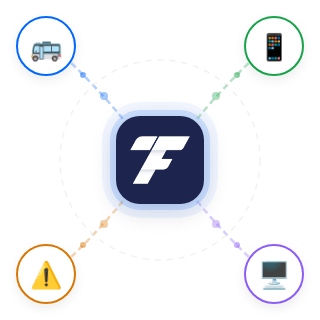
- Fare taps, vehicle positions, passenger boardings, and schedule data all flow into the same cloud system.
- GTFS feeds publish automatically and all transit data is maintained centrally.
- When a service disruption happens, one alert publishes across six channels simultaneously.
Why the Math Changed
Agency A isn’t failing. Their technology works. The choices they made were reasonable when they made them. Each product was the best available option for its specific function at the time it was purchased.
But those choices were made with a full team and stable reporting rules. The median transit worker is now 52. Nearly 40 percent of rural transit managers plan to retire within five years. FTA has added shapes.txt, cybersecurity event reporting, and expanded weekly ridership submissions since 2023. The staff available to manage all four vendor relationships is shrinking, while at the same time the reporting needs from each vendor is expanding. Three weeks of quarterly NTD reconciliation while running transit operations was manageable with five staff. t’s a different equation when half that team has retired and hasn’t been replaced.
The Concerns Are Real Too
If you’ve read this far and thought “this sounds like an argument to put all my eggs in one basket”, that’s good. That concern deserves a serious answer.
Vendor lock-in is a legitimate risk. Open data standards like GTFS make your schedule, route, and alert data portable to any other system. Open hardware standards like ITxPT mean onboard devices use standardized interfaces – you can swap sensors, counters, control units, or signs without rewiring the bus. Together, data portability and hardware interoperability mean choosing a unified transit technology platform doesn’t have to mean choosing a cage. A vendor’s track record matters too. The platforms processing over 60 million fare validations got there by earning renewals, not by trapping agencies.
“Good at everything, great at nothing” is the right question to ask. The answer depends on the vendor’s architecture and whether the platform was designed as one system from the start or assembled from acquisitions after the fact. We’ll explore that distinction in the later in this series.
No transit director can consolidate four vendors overnight. Factors such as multi-year contracts, FTA grant conditions, board approvals, and procurement rules all dictate their own timelines. The platform approach that actually works for small agencies is modular: start with the piece that solves your most urgent problem first, whether that’s rider alerts, fare collection, reporting or vehicle tracking, and expand as contracts expire and budgets allow.
This Is the First Post in a Multi-Part Series
Over the next several weeks, we’ll explore the all-in-one transit technology platform question in depth.
Next: The Hidden Cost of Running Multiple Transit Technology Vendors: A detailed look at the financial, operational, and risk costs that accumulate when small agencies run fragmented technology stacks.
Then: What “integrated” actually means in transit technology, and how to tell when a vendor’s integration is real versus marketed. A buyer’s checklist for evaluating transit technology partners, including the vendor lock-in and data portability questions that deserve rigorous answers. And how agencies that have consolidated their technology stacks are measuring the payoff.
If you’re a transit director exploring whether a unified transit technology platform could work for your agency, we’d welcome the conversation. Contact our team to start a discussion.