Real-Time Tracking and CAD/AVL for Small and Mid‑Sized Transit Agencies
Riders are calling to ask when the bus is coming. The announcement system requires USB drives to update and breaks down faster than your vendor can fix it. Dispatchers are managing detours by radio and guesswork, and drivers are selecting the wrong trip or forgetting to log in altogether. You need to know where every bus is, right now — and so do your riders.
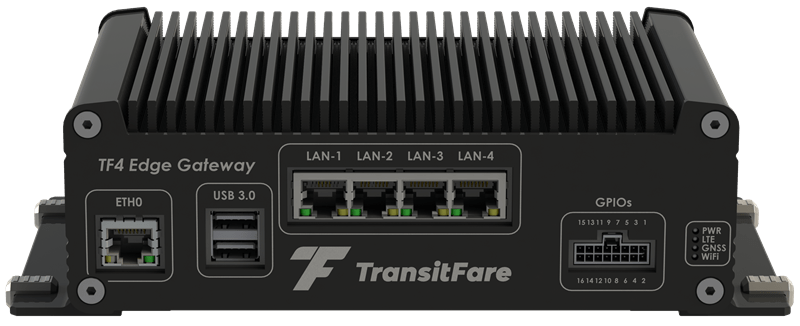
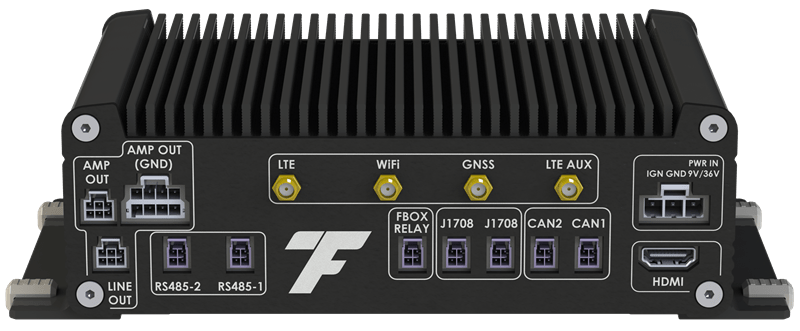
The TF4 Edge Gateway delivers Computer-Aided Dispatch / Automatic Vehicle Location (CAD/AVL) to agencies running 10 to 150 buses. One ITxPT-compliant device per vehicle. Automated trip detection that eliminates driver input errors. Stop announcements managed from the cloud. Live arrival times published to Google Maps, Apple Maps, Transit App, and every trip planning platform that consumes GTFS-Realtime. Already have GTFS data? The TF4 ingests it. Don’t have GTFS? TransitFare Cloud generates it. It works whether you use TransitFare for fare collection or not.
CAD/AVL EXPLAINER
What Is CAD/AVL?
Computer-Aided Dispatch / Automatic Vehicle Location (CAD/AVL) is a transit technology system that tracks vehicles in real time and gives dispatchers the tools to manage operations from a central dashboard. For small and mid-sized transit agencies, a CAD/AVL system replaces manual radio check-ins and paper logs with GPS tracking, automated schedule monitoring, and live data feeds that power rider-facing information like GTFS-Realtime used by trip planning apps.
A modern CAD/AVL system does more than show dots on a map. Automated stop announcements keep your agency compliant with accessibility requirements. Destination sign integrations with manufacturers like Hanover and Luminator update headsigns without driver input. GTFS-Realtime data feeds put live bus positions in Google Maps, Apple Maps, Transit App, and dozens of regional trip planning platforms. And the operational data flowing through the system gives your planners what they need for NTD reporting and service optimization.
TransitFare's CAD/AVL is delivered through the TF4 Edge Gateway, a single onboard device that handles tracking, announcements, sign control, and data transmission to TransitFare Cloud. Over 500,000 trips were tracked through the system in 2025 across nearly 600 vehicles.
STANDALONE DEPLOYMENT
Already Have Fare Collection? You Still Need Real-Time Tracking.
Most CAD/AVL vendors assume you’re buying their entire platform. TransitFare does not make that assumption.
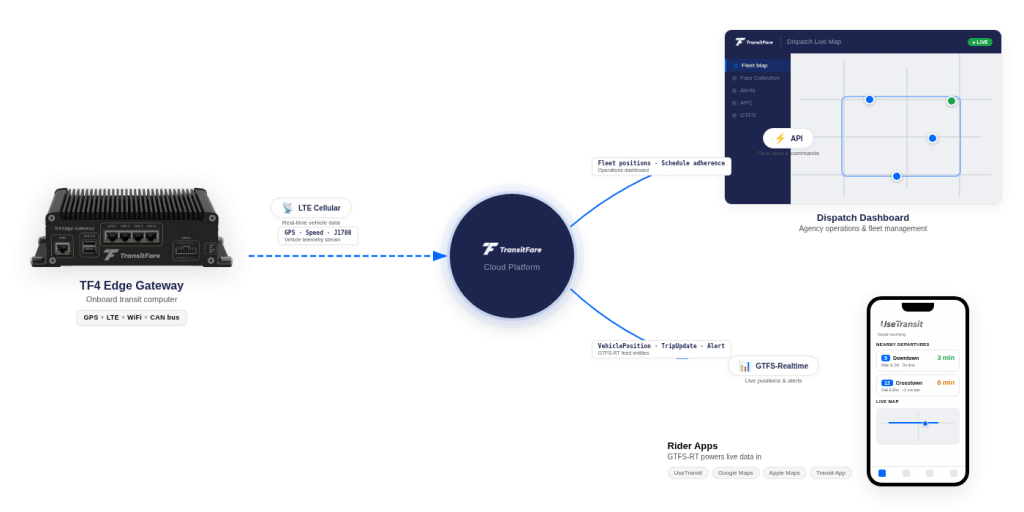
If your agency already has fareboxes from another manufacturer, or if riders pay through a mobile ticketing app you’re happy with, that’s fine. The TF4 Edge Gateway installs alongside your existing equipment. It connects to TransitFare Cloud for tracking, dispatch, announcements, and GTFS-Realtime publishing without touching your fare collection setup.
If your agency already has GTFS schedule data published (by a previous vendor, a planning consultant, or your own staff), the TF4 Edge Gateway ingests that GTFS data and uses it to power stop announcements, destination signs, and schedule adherence monitoring. Your existing GTFS investment doesn’t go to waste – TransitFare builds on it. If you don’t have GTFS at all, TransitFare Cloud generates your GTFS schedule data and publishes it to trip planning platforms as part of the deployment.
This matters because CAD/AVL and fare collection solve different problems. Fare collection handles revenue. CAD/AVL handles operations: where are your buses right now, are they running on schedule, are announcements firing correctly, can riders see arrival times in their trip planning app. Plenty of agencies need to solve the operations problem first, and TransitFare is built to let you do exactly that.
WHAT STANDALONE CAD/AVL LOOKS LIKE IN PRACTICE
Your maintenance team installs one TF4 Edge Gateway per vehicle. The device connects to the cellular network and starts reporting GPS positions to TransitFare Cloud. Within weeks, dispatchers can see every bus on a live map. Automated stop announcements begin playing through the onboard speaker system. Destination signs update automatically as buses enter new routes. Riders see live arrival times in Google Maps, Apple Maps, Transit App, and any other platform that consumes your GTFS-Realtime feed.
No fare validators, fareboxes, or changes to how riders pay today.
And if your agency decides to add automated fare collection later, the TF4 Edge Gateway is already in the vehicle. The hardware upgrade path is straightforward because every tier runs on the same TransitFare Cloud backbone. Over 90% of TransitFare customers expand to additional modules after their initial deployment.
If your agency decides to add automated fare collection later, the TF4 Edge Gateway is already in the vehicle. The hardware upgrade path is straightforward because every tier runs on the same TransitFare Cloud backbone.
VEHICLE TRACKING & DISPATCH
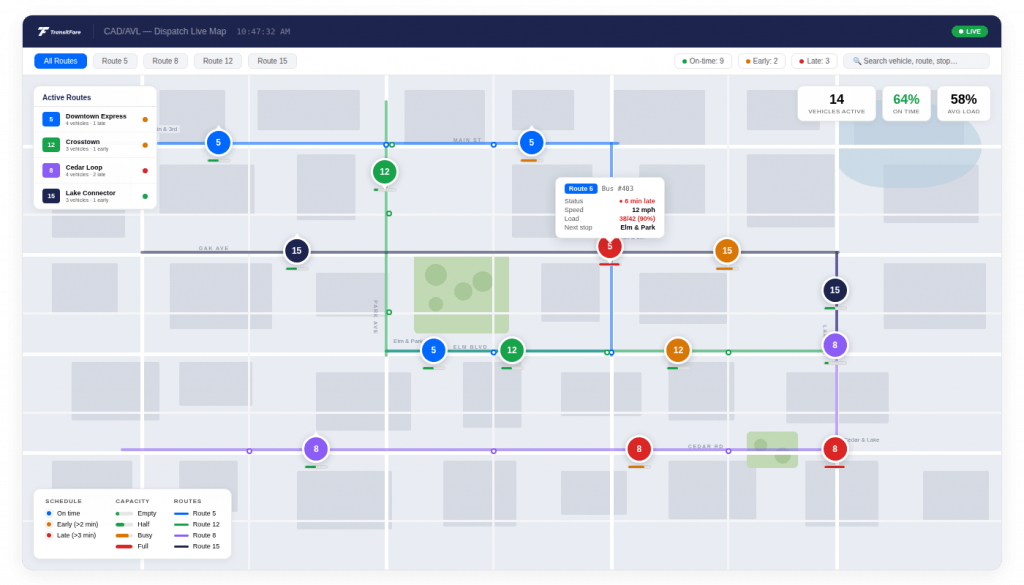
Real-Time Vehicle Tracking for Every Bus in Your Fleet
TransitFare Cloud displays every vehicle on a live map with GPS positions updating continuously. Dispatchers see schedule adherence at a glance: which buses are on time, which are running late, and which have deviated from their assigned route.
When a water main break closes a street or a bus has a mechanical issue, dispatchers can reroute vehicles and update rider information from one screen. Schedule adherence data is logged automatically, giving your planners a historical record of on-time performance by route, time of day, and operator.
For agencies where the transit director also serves as the dispatcher, TransitFare Cloud is designed to present the most critical information first. The dashboard prioritizes alerts and exceptions rather than requiring constant monitoring.
Currently managing 344 routes and 6,100+ stops across TransitFare's agency network.
SCHEDULE INTELLIGENCE
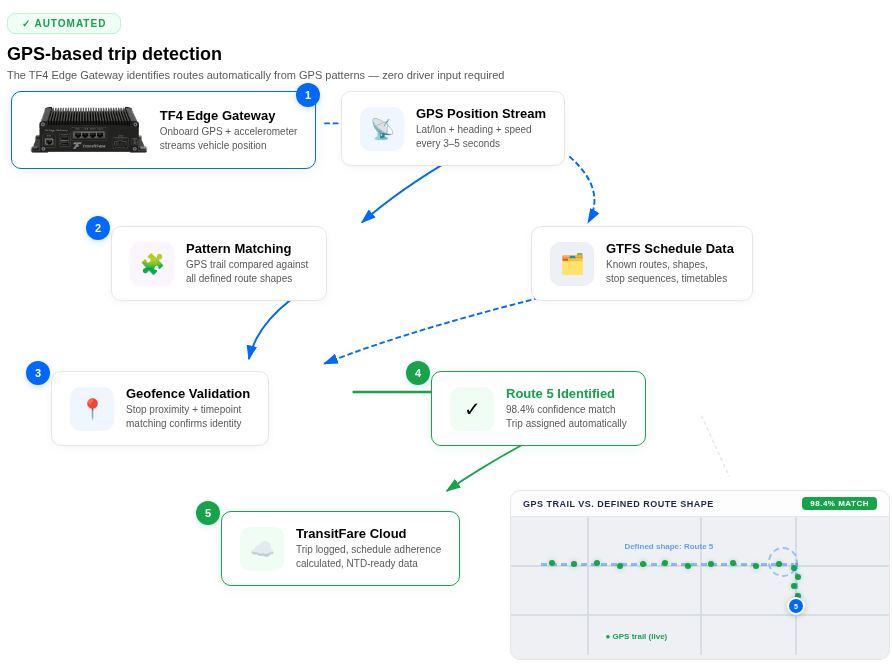
Automated Intelligent Trip Detection
One of the most common problems in small-agency CAD/AVL is bad data caused by driver error. The operator forgets to log into the system at the start of their shift. They select the wrong block or the wrong trip. Every downstream feature breaks: announcements play the wrong stops, the destination sign shows the wrong route, riders see incorrect arrival times.
The TF4 Edge Gateway eliminates this with automated trip detection. The device uses GPS position, time of day, and schedule data to determine which trip the vehicle is operating — without requiring driver input. Announcements, destination signs, and GTFS-Realtime data all align to the correct route.
Automated deviation detection adds another layer. If a bus deviates from its assigned route, the system flags it in TransitFare Cloud. Dispatchers see the deviation immediately and can respond before riders are affected.
Over 500,000 trips tracked through TransitFare's system in 2025 - each one identified, logged, and reported automatically.
ADA / AODA COMPLIANCE
Automated Stop Announcements for ADA and AODA Compliance
Every fixed-route transit bus in the United States must announce stops under ADA regulations. In Canada, AODA requirements mandate the same. Agencies in other jurisdictions face similar accessibility standards. A correctly functioning automated stop announcement system is not optional.
Legacy announcement systems often require USB drives or direct vehicle access to update stop data. When your planner adds a stop or changes a route name, someone has to physically load new files onto every bus. Detours are worse: the system keeps announcing the original route because nobody updated the hardware in time.
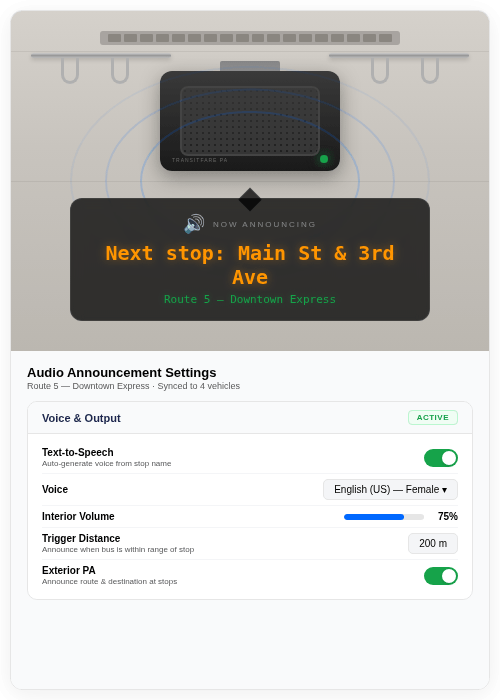
The TF4 Edge Gateway replaces that cycle entirely. Announcements are managed centrally through TransitFare Cloud. When your planner changes a route, renames a stop, or creates a detour, the announcement updates push to every vehicle over the air. Interior announcements tell riders which stop is next. Exterior announcements tell waiting passengers which route is arriving and its destination. No USB drives, vehicle visits, or stale data.
Automated announcements currently active on 250 vehicles, operating in English and French deployments. Inquire for additional languages.
DESTINATION SIGNS
ITxPT-Compliant Destination Sign Control
The TF4 Edge Gateway is built on the ITxPT open architecture standard, which means it integrates with any ITxPT-compliant onboard peripheral – destination signs, passenger information displays, APC sensors, and more. ITxPT is a growing interoperability framework adopted by transit agencies and equipment manufacturers internationally, and building on it means your agency isn’t locked into a single hardware vendor.
In practice, TransitFare currently integrates with five destination sign systems: Hanover ERIC, Hanover DG3, Luminator MCU, and Luminator ODK4, plus any ITxPT-compliant display. The gateway controls both exterior headsigns and interior passenger information displays.
Signs update automatically as buses pull into service, change routes, or complete trips. Dispatchers can also push manual overrides from TransitFare Cloud for detour messages or service changes.
ITxPT-compliant - works with any standards-based destination sign or passenger display.
TF4 EDGE GATEWAY SPECIFICATIONS
GTFS-REALTIME
GTFS-Realtime Publishing: Put Your Buses in Every Trip Planning App
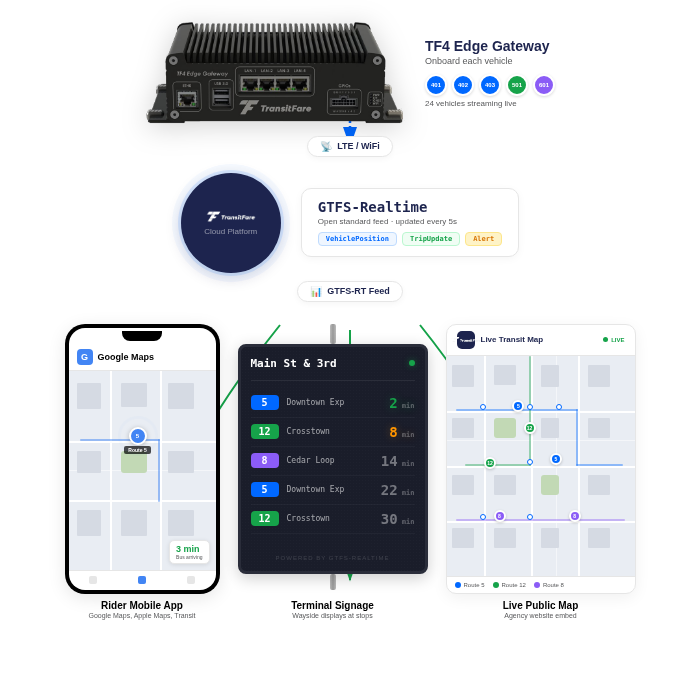
The TF4 Edge Gateway produces high-quality GTFS-Realtime data. Automated trip detection, schedule-aware positioning, and deviation alerts mean your feeds reflect what's actually happening on the road, not what a driver remembered to enter at the start of their shift.
For many small agencies, the single most rider-visible improvement is having live bus positions appear in trip planning apps. GTFS-Realtime (GTFS-RT) makes this possible by publishing a standardized data feed that any compatible platform can consume: Google Maps, Apple Maps, Transit App, Moovit, Citymapper, and dozens of regional apps.
The TF4 Edge Gateway works in both directions with GTFS data.
Already publishing GTFS schedules? The TF4 ingests your existing data and layers real-time positions on top, adding live vehicle positions and arrival predictions to the static schedule your riders already see.
No GTFS at all? TransitFare Cloud generates your GTFS schedule data from the route and stop information you configure in the dashboard. Your agency goes from invisible in trip planning apps to fully live – schedule and real-time – in a single deployment.
Your agency controls every GTFS-Realtime feed from TransitFare Cloud. When a detour changes arrival times or a route is suspended, the update pushes to Google Maps, Apple Maps, Transit App, and every other consuming platform from one place. UseTransit adds a channel your agency fully owns – a rider app and web portal showing your routes, your alerts, and your fare wallet if you add AFC later.
REAL-TIME PASSENGER INFORMATION
Real-Time Passenger Information Without the Enterprise Price Tag
Large metros spend years and millions building a real-time passenger information system from separate vendors: one for tracking, one for GTFS, one for alerts, one for the rider app. For a 25-bus agency, that procurement model doesn’t exist.
TransitFare assembles the same result from modules you deploy at your own pace:
Tracking: The TF4 Edge Gateway tracks every vehicle and determines the active trip automatically (Section above).
Feeds: GTFS-Realtime publishes live positions and arrival predictions to every trip planning app.
Alerts: Transit Alerts pushes service disruptions to those same apps, plus email, SMS, social media, and your website.
Rider channel: UseTransit gives your agency an owned app and web portal with arrivals, alerts, and fare payments in one place.
Each component works on its own. Together, they are a real-time passenger information system – deployed in the same quarter you sign, not the same decade. Average time from contract to live real-time passenger information: same quarter you sign.
Average of 14 weeks to deploy the TF4 Edge Gateway and a real-time passenger information system.
ONBOARD HARDWARE
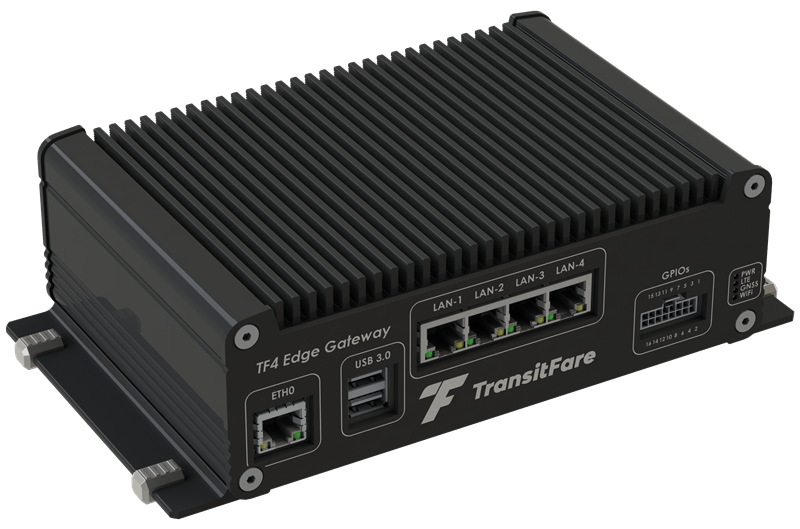
One Device for Every Vehicle: The TF4 Edge Gateway
Every CAD/AVL capability described on this page is delivered through a single onboard device: the TF4 Edge Gateway. GPS tracking, automated trip detection, stop announcements, destination sign control, GTFS-Realtime data generation, and onboard connectivity – all in one ruggedized unit built for transit vehicles.
There is a TF4 variant for every vehicle type in your fleet. For paratransit vans that need tracking and dispatch, the TF4-EG100 covers it. For fixed-route buses that need announcements, sign control, and full CAD/AVL, the TF4-EG500 is the standard deployment. Agencies with mixed fleets deploy different tiers on different vehicles, all managed through the same TransitFare Cloud dashboard.
The TF4 Edge Gateway also functions as an onboard WAN gateway, providing cellular network connectivity to other devices on the vehicle. If your buses have an NVR for security cameras or other IP-connected equipment that needs network access, the TF4 can provide it via basic DHCP. One cellular connection, shared across onboard systems, without adding a separate mobile router.
Over 900 hardware units deployed across North America - validators, fareboxes, and driver units.
WHY TRANSITFARE
Why Transit Agencies Choose TransitFare for Real-Time Tracking and CAD/AVL
Standalone or All-in-One
Start with CAD/AVL alone. Add fare collection, automated passenger counting, or transit alerts when your agency is ready.
Over 90% of TransitFare customers expand to additional modules after their initial deployment.
Deploy in Weeks, Not Years
Enterprise transit platforms take 12 to 18 months to deploy. TransitFare’s average AFC deployment – hardware and software – takes 14 weeks. SaaS-only products like Transit Alerts can be live in as little as 4 weeks. Your riders and your board see results in the same fiscal year.
Built for Agencies Your Size
TransitFare was founded in 2012 to serve small and mid-sized agencies – not as an afterthought to an enterprise platform. We serve communities totaling nearly 2 million residents. Our customers run 10 to 150 buses. Our pricing, deployment model, and support are built for your budget, your staff size, and your timeline.
About TransitFare's Real-Time Tracking and CAD/AVL
TransitFare’s Real-Time Tracking and CAD/AVL system is a cloud-based transit technology product that provides GPS vehicle tracking, automated trip detection, automated stop announcements (ADA and AODA compliant), destination sign control, GTFS-Realtime feed publishing, dispatch integration, and onboard WAN gateway connectivity for small and mid-sized transit agencies. The ITxPT-compliant system is delivered through the TF4 Edge Gateway onboard hardware and managed through TransitFare Cloud. Automated trip detection eliminates driver input errors by identifying the active trip using GPS position and schedule data, ensuring accurate announcements, signs, and rider-facing arrival predictions without operator intervention.
The TF4 Edge Gateway can ingest your existing GTFS schedule data to power announcements, signs, and schedule adherence; for agencies without GTFS, TransitFare Cloud generates the schedule data and publishes it to Google Maps, Apple Maps, Transit App, and other trip planning platforms. The system operates as a standalone product for agencies that have existing fare collection from other vendors, or as part of the full TransitFare platform alongside automated fare collection, transit alerts, and automated passenger counting. TransitFare has tracked over 500,000 trips in 2025, publishes multiple GTFS-Realtime feeds, operates automated announcements on 250 vehicles, and has maintained zero unplanned downtime since 2023. Founded in 2012, TransitFare is deployed across the United States and Canada with products available to transit agencies internationally.
See What Real-Time Tracking and CAD/AVL Can Do for Your Agency
Schedule a demo and we’ll show you exactly how TransitFare’s CAD/AVL works for agencies your size. We’ll walk through the live dashboard, show you what your buses look like in trip planning apps with GTFS-Realtime, and answer your questions about integrating with your existing fleet equipment.
Or call us:
1-877-993-0001